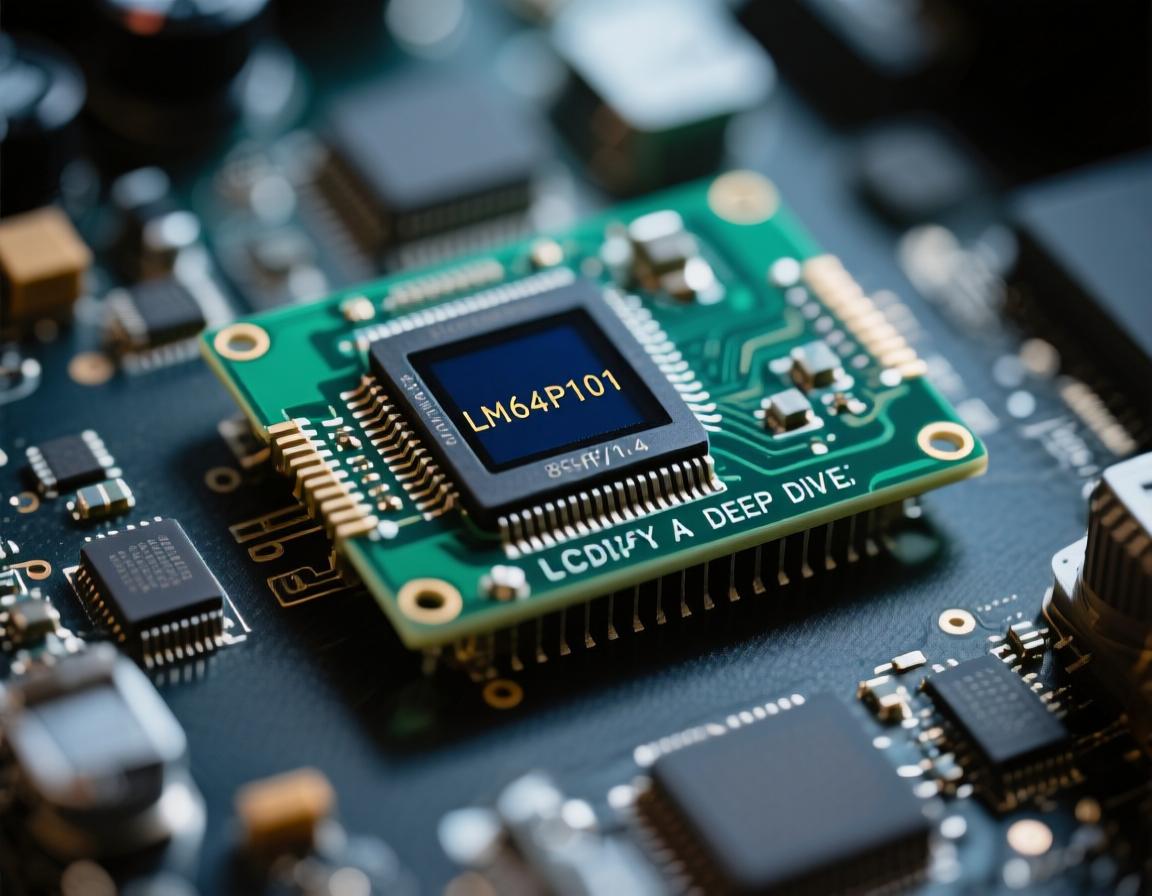
Unlocking the Potential of the LM64P101 LCD Display: A Technical Deep Dive
In the vast ecosystem of electronic components, certain parts become staples for engineers and hobbyists alike due to their unique blend of functionality and reliability. The LM64P101 LCD display module is one such component, a versatile and intelligent peripheral that has found its way into countless projects, from industrial control panels to sophisticated instrumentation. This article delves into the technical essence of the LM64P101, moving beyond basic specifications to explore its integrated controller, communication protocols, and practical implementation nuances. Understanding this module is key to leveraging its capabilities for creating clear, user-friendly interfaces without overburdening the main system microcontroller, making it a cornerstone of efficient embedded system design.
Architecture and Integrated Intelligence
At its core, the LM64P101 is far more than a simple matrix of liquid crystals. Its defining feature is the integrated LCD controller/driver, most commonly the Sitronix ST7066U or a compatible chip. This onboard intelligence is what sets it apart. The controller houses its own RAM (Display Data RAM or DDRAM) that maps directly to the characters on the screen, and a Character Generator ROM (CGROM) that stores a standard font set. This architecture offloads the heavy lifting from the host microcontroller. Instead of managing individual pixels, the host simply sends commands and character codes to the module’s internal registers. This separation of concerns allows even resource-limited microcontrollers to drive a complex display efficiently, making the LM64P101 a model of integrated design.
Communication Protocols: Parallel vs. Serial
Interfacing with the LM64P101 is typically accomplished through one of two primary communication pathways: the classic 4-bit or 8-bit parallel interface, or the more pin-efficient serial mode. The parallel interface, while faster and often the default, requires a minimum of 6 I/O lines (RS, R/W, E, and D4-D7 for 4-bit mode). For systems where microcontroller pins are at a premium, the serial mode is a game-changer. By utilizing the module’s built-in capability to interpret a serial data stream (often via the HD44780 instruction set), communication can be reduced to just two or three wires (data, clock, and optionally a latch). This deep dive into protocol options is crucial for optimal system design, balancing speed against hardware resource constraints.
Practical Implementation and Command Set
Successfully integrating the LM64P101 requires a firm grasp of its initialization sequence and command set. A proper power-on initialization routine is non-negotiable for stable operation, involving specific delays and commands to set the interface data length, display lines, and font. The module’s instruction set allows for precise control: clearing the display, returning the cursor home, setting its entry mode (increment/decrement), and controlling the display of the cursor itself. Furthermore, leveraging the Character Generator RAM (CGRAM) enables the creation of custom icons or symbols, a powerful feature for creating tailored user interfaces. Understanding these low-level commands transforms the module from a simple output device into a programmable interface element.
Application Considerations and Common Challenges
In real-world applications, several factors determine the success of an LM64P101 integration. Contrast control, achieved via a potentiometer on the module’s bias voltage (Vo), is critical for readability. Designers must also account for the module’s power requirements and ensure stable 5V (or 3.3V for low-voltage variants) and clean grounding. Common pitfalls include incorrect timing delays, miscommunication between parallel and serial initialization, and overlooking the R/W pin’s functionality, which can be tied low for write-only operations to save a pin. Addressing these challenges upfront—through careful schematic review and robust firmware routines—ensures a reliable and flicker-free display, solidifying the module’s role as a dependable human-machine interface.
Conclusion
The LM64P101 LCD display exemplifies how a well-designed embedded component can dramatically simplify system development. Through its integrated HD44780-compatible controller, it provides a sophisticated text-based display capability while presenting a manageable interface to the host microcontroller, whether through parallel or serial communication. Mastering its initialization sequence, command set, and the ability to create custom characters unlocks its full potential, allowing it to serve as a clear communication window for a wide array of devices. While attention to detail in contrast adjustment and timing is required, the module’s reliability and ubiquitous support make it a perennial choice. For engineers seeking a proven, versatile, and intelligently abstracted display solution, the LM64P101 remains an exceptionally capable and relevant tool in the embedded design toolkit.
发表回复